

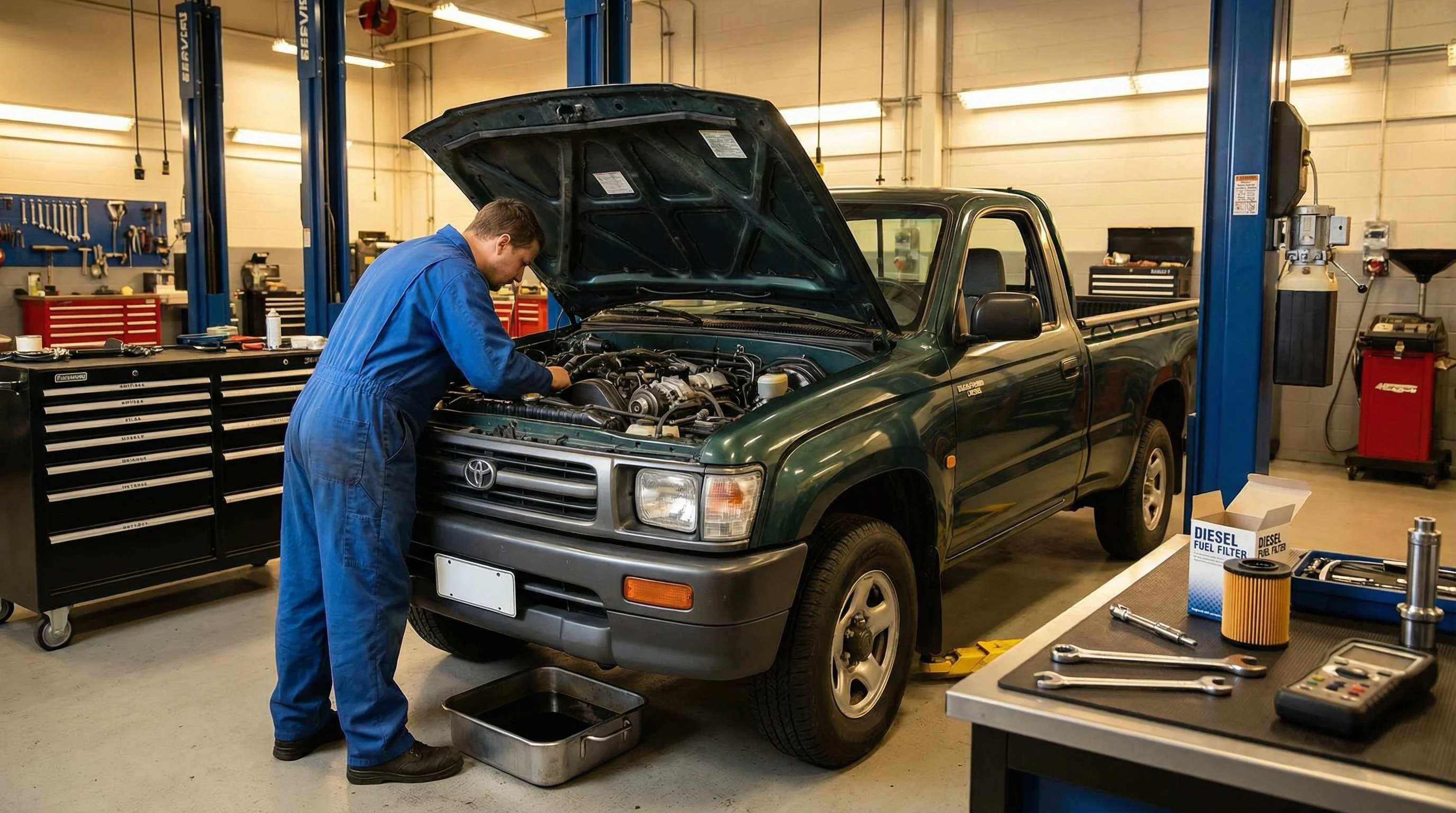
If you drive a diesel truck in the Dayton area, you already know it's not the same as owning a gas vehicle. Diesel engines hold more oil, use a different oil specification, have fuel filters that need regular replacement, and run emissions systems that gas engines don't have. Skip or delay any of these items and you're looking at repairs that cost significantly more than the maintenance would have.
This guide covers the key maintenance intervals for the most common light-duty diesel engines on the road today: the 3.0L Duramax (Mini Max), 6.6L Duramax, 6.7L Powerstroke, 6.7L Cummins, and EcoDiesel. These are the engines we see most often at Murphy's Autocare in Beavercreek and Centerville.
Oil & Filter Changes
Diesel oil changes are the single most important maintenance item, and they're different from gas engine oil changes in several ways:
Volume. Diesel engines hold significantly more oil than gas engines. A 6.7L Powerstroke holds about 13 quarts. A 6.7L Cummins holds about 12 quarts. Even the smaller 3.0L Duramax holds around 7 quarts. Compare that to a typical gas engine at 5-6 quarts.
Specification. Diesel engines require oil that meets specific standards — CK-4 for most heavy-duty diesels, dexos D for the 3.0L Duramax, and ACEA C3 for the EcoDiesel. Using the wrong oil can cause premature wear and may void warranty coverage. This isn't marketing — the engineering requirements are genuinely different.
Intervals by engine:
| Engine | Manufacturer Interval | Our Recommendation (with towing) |
|---|---|---|
| 3.0L Duramax (Mini Max) | Oil Life Monitor (~7,500-10,000 mi) | 7,500 miles |
| 6.6L Duramax | 7,500 miles | 5,000-7,500 miles |
| 6.7L Powerstroke | 7,500-10,000 miles | 5,000-7,500 miles |
| 6.7L Cummins | 15,000 miles (factory) | 7,500-10,000 miles |
| EcoDiesel | Oil Life Monitor (~10,000 mi) | 7,500 miles |
The Cummins factory interval of 15,000 miles is aggressive. Most independent diesel mechanics — including ours — recommend cutting that in half, especially if you tow regularly or drive in dusty conditions.
Fuel Filter Replacement
Gas engines don't have a serviceable fuel filter (most modern gas vehicles have a lifetime filter in the tank). Diesel engines do, and it's a critical maintenance item.
Diesel fuel is less refined than gasoline and can contain water, particulates, and contaminants that damage high-pressure fuel injection components. The fuel filter catches these before they reach the injectors and fuel pump. A clogged filter causes loss of power, rough running, and hard starting. A filter that lets contaminants through can destroy a $3,000+ fuel pump.
Recommended interval: Every 15,000-20,000 miles for most engines. Some manufacturers recommend shorter intervals — the 6.7L Powerstroke, for example, has a primary and secondary filter, and Ford recommends replacement every 15,000 miles.
If you buy fuel from stations with lower turnover (rural stations, small-town pumps), consider shorter intervals. Fuel that sits in underground tanks longer tends to accumulate more water and sediment.
DEF (Diesel Exhaust Fluid)
Every diesel truck built after 2010 uses DEF — a urea-based solution injected into the exhaust to reduce nitrogen oxide emissions. Your truck has a DEF tank (usually 5-8 gallons) that needs periodic refilling.
How often: DEF consumption varies by engine and driving conditions, but most trucks use about 2-3 gallons per 1,000 miles of driving. You'll get a dashboard warning when the level is low. Don't ignore it — if the tank runs dry, the truck will progressively limit speed and eventually refuse to start.
Quality matters: Use DEF that meets ISO 22241 specification (API certified). Don't use off-brand or expired DEF. Contaminated DEF can crystallize in the injector and cause expensive repairs.
Air Filter
Diesel engines move a lot of air through the turbocharger, and a restricted air filter directly impacts performance, fuel economy, and turbo health.
Recommended interval: Every 20,000-30,000 miles, or sooner if you drive on gravel roads or in dusty conditions. Ohio construction season (roughly April through November) kicks up a lot of dust on I-75 and I-675 — keep an eye on your filter during summer months.
Cooling System
Diesel engines generate more heat than gas engines, especially under load. The cooling system works harder, and coolant degrades over time.
Recommended interval: Coolant flush every 100,000 miles or 5 years, whichever comes first. Some manufacturers specify different intervals — check your owner's manual or ask us. Between flushes, have the coolant concentration and condition tested at each oil change. We do this as part of our digital inspection.
Why it matters for diesel: A cooling system failure on a diesel engine under load (towing on I-75 in July) can cause head gasket failure, which is a multi-thousand-dollar repair. Prevention is cheap by comparison.
Glow Plugs / Grid Heater
Diesel engines don't have spark plugs — they use compression ignition. But they do need help starting in cold weather, which is where glow plugs (or an intake grid heater on the Cummins) come in.
Recommended interval: Glow plugs typically last 80,000-100,000 miles. The Cummins grid heater relay is a common failure point and should be tested before winter. If you notice longer crank times when temperatures drop below freezing, have the starting system checked before Ohio's deep winter hits.
The 3.0L Duramax Oil Pump Belt — A Unique Item
The 3.0L Duramax has a maintenance item that no other engine on this list shares: an oil pump belt. Most engines drive the oil pump with a chain or gear. The Mini Max uses a toothed belt, and it wears over time.
GM hasn't published a hard replacement interval, but most technicians recommend inspection starting at 50,000-60,000 miles. If the belt shows signs of wear, cracking, or stretching, replace it. If it breaks, the oil pump stops and the engine can be destroyed in seconds.
This is one of the reasons we recommend the 3.0L Duramax be serviced at a shop that knows the engine. Many general repair shops don't even know this belt exists.
Putting It All Together
Here's a simplified schedule you can use as a baseline:
| Service | Interval |
|---|---|
| Oil & filter change | Every 5,000-7,500 miles (towing) or per OLM |
| Fuel filter replacement | Every 15,000-20,000 miles |
| Air filter | Every 20,000-30,000 miles |
| DEF top-off | As needed (watch dashboard) |
| Cooling system flush | Every 100,000 miles / 5 years |
| Glow plugs / grid heater test | Every 80,000-100,000 miles / before winter |
| Oil pump belt inspection (3.0L only) | Starting at 50,000-60,000 miles |
Your specific intervals may vary based on your engine, how you use the truck, and the conditions you drive in. Towing regularly, driving in extreme heat or cold, and frequent short trips all accelerate wear.
Schedule Your Diesel Service
Murphy's Autocare services all five of these diesel platforms at our Beavercreek and Centerville locations. We use the correct oil specification, the right filters, and we check diesel-specific items that a general shop might miss.
- Beavercreek: 937-426-2886 — 3815 Dayton-Xenia Rd
- Centerville: 937-433-0140 — 100 N Main St
Schedule an appointment online →
Learn more about our diesel services →
Stay connected with us!
